
17 Jan Digital Cage Cards in your Hands start Quality
Digital Cage Cards for Ergonomics on Digitalization
In modern laboratory animal facilities, teams often discuss digitalization in terms of animal management systems, digital cage cards, and automated reporting. These discussions typically focus on data completeness, traceability, and regulatory compliance. However, they frequently overlook a decisive success factor: ergonomics at the changing station.
At this physical point of execution—where cages are opened, animals are handled, and actions are confirmed—digitalization either improves quality or adds unnecessary complexity. If digital tools do not align with natural movements and workflows, they increase cognitive load instead of reducing it.
The Hidden Impact of Movement and Posture
First, well-placed tools, free hands, minimal movements, and context-sensitive digital cage card support significantly reduce cognitive load. Staff no longer need to remember intermediate steps, search for information, or mentally reconcile planned and executed actions.
As a result, teams prevent mix-ups, improve data quality, and stabilize daily processes. At the same time, staff work more calmly, safely, and reproducibly, even under time pressure or high workload.
Nevertheless, many facilities underestimate how strongly muscle memory, posture, reach, and sightlines influence throughput and error rates. Small inefficiencies accumulate quickly in repetitive tasks. Consequently, every awkward movement and unnecessary touch consumes time and attention and ultimately reduces quality, consistency, and focus.
Hygiene Begins with Motion and Touch
Importantly, the changing station represents a hygienically sensitive area. Here, every physical action has hygienic implications. Therefore, every unnecessary movement, re-grip, or additional hand motion increases contamination risk and undermines barrier concepts.
When workflows lack ergonomic design, they force exactly these unnecessary actions—even when digital planning appears correct on paper. Poor ergonomics can negate the benefits of otherwise well-designed digital processes by introducing avoidable risks at the point of execution.
Digitalization Needs Ergonomics
Digital and ergonomic processes depend on each other. Without ergonomics, digitalization turns into a burden that slows down work and frustrates users. In contrast, with ergonomics, digitalization becomes a leap in quality, enabling staff to focus on animals rather than interfaces.
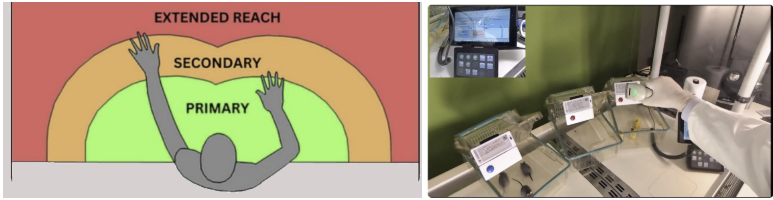
To demonstrate this, we deliberately minimized movements within a 70-centimeter hand range using digital cage cards. We implemented this approach with a new device called CageTalkers®-Assist, designed specifically for use at the changing station.
We documented the practical results in two demonstration videos:
https://youtu.be/MFTH6I0fdf0 (4:07) and https://youtu.be/6UW38ZgnBrc (1:19).
These examples show how reducing reach, re-gripping, and visual searching directly improves speed, hygiene, and process reliability.
Therefore, ergonomics at the changing station does not represent a nice-to-have. Instead, it defines a central quality and safety factor in daily animal husbandry and a prerequisite for reliable digital documentation.
Quality Is Created at the Cage
CageTalkers®-Assist combines validated, pre-registered processes with thoughtfully designed ergonomics directly at the workplace. By guiding users step by step and placing digital confirmation exactly where actions occur, the system supports natural working behavior.
As a result, teams achieve safe workflows with minimal physical and mental strain. Ultimately, quality emerges exactly where it matters most: at the cage, in the animal room, within the real process.
Thus, anyone seeking to improve quality, animal welfare, and data integrity sustainably must rethink digitalization. Starting at the desk with careful preregistration, digitalization must continue consistently at the changing station—with the hands of animal care staff.