

29 Jan Clean Room serves 70 cages to the glovebox
Infrastructure Shift: From Fixed Facilities to Deployable Platforms
At its core, IsoSpin transforms cleanroom infrastructure from a fixed, capital-intensive facility into a modular, software-integrated platform, thereby shifting the model from building-based CAPEX to deployable, utilization-driven infrastructure that follows research demand instead of constraining it.
Structural Pressure on Traditional Animal Facilities
For years, researchers, clinicians, and technicians have required clean rooms that are available on demand, scalable, reproducible, and easy to manage; however, traditional centralized facilities were designed around permanent construction, long depreciation cycles, and high baseline occupancy — assumptions increasingly misaligned with project-based funding, decentralized campuses, and variable animal numbers.
While overall preclinical animal numbers decline, research complexity and regulatory expectations continue to rise, meaning institutions must now deliver higher-quality output with fewer animals and fewer staff; consequently, infrastructure must increase per-animal value creation while reducing idle capacity, unused floor space, and logistics overhead — a shift from capacity ownership toward capacity efficiency.
Welfare as a Scientific and Economic Variable
At the same time, animal welfare requirements increasingly correlate with data quality and reproducibility, linking ethical performance to scientific and economic outcomes; therefore, reducing handling stress, transport distances, and environmental variability becomes not only a compliance factor but also a contributor to experimental reliability and lower study repetition costs.
Replacement Cycle as Market Inflection Point
Meanwhile, a substantial global installed base of 15–20-year-old IVC racks is reaching end of life, triggering a replacement cycle across thousands of facilities and representing a non-discretionary reinvestment wave; in this context, operators are not merely upgrading hardware but reassessing infrastructure models, opening a window for platform substitution rather than incremental replacement.
Cross-Domain Demand Expands Addressable Market
Beyond animal research, plant biotechnology and cell-based production workflows exhibit similar sterile-environment requirements, thereby broadening the addressable market and supporting multi-application utilization, which improves asset productivity and strengthens the economic logic of a platform solution.
IsoSpin Platform Architecture
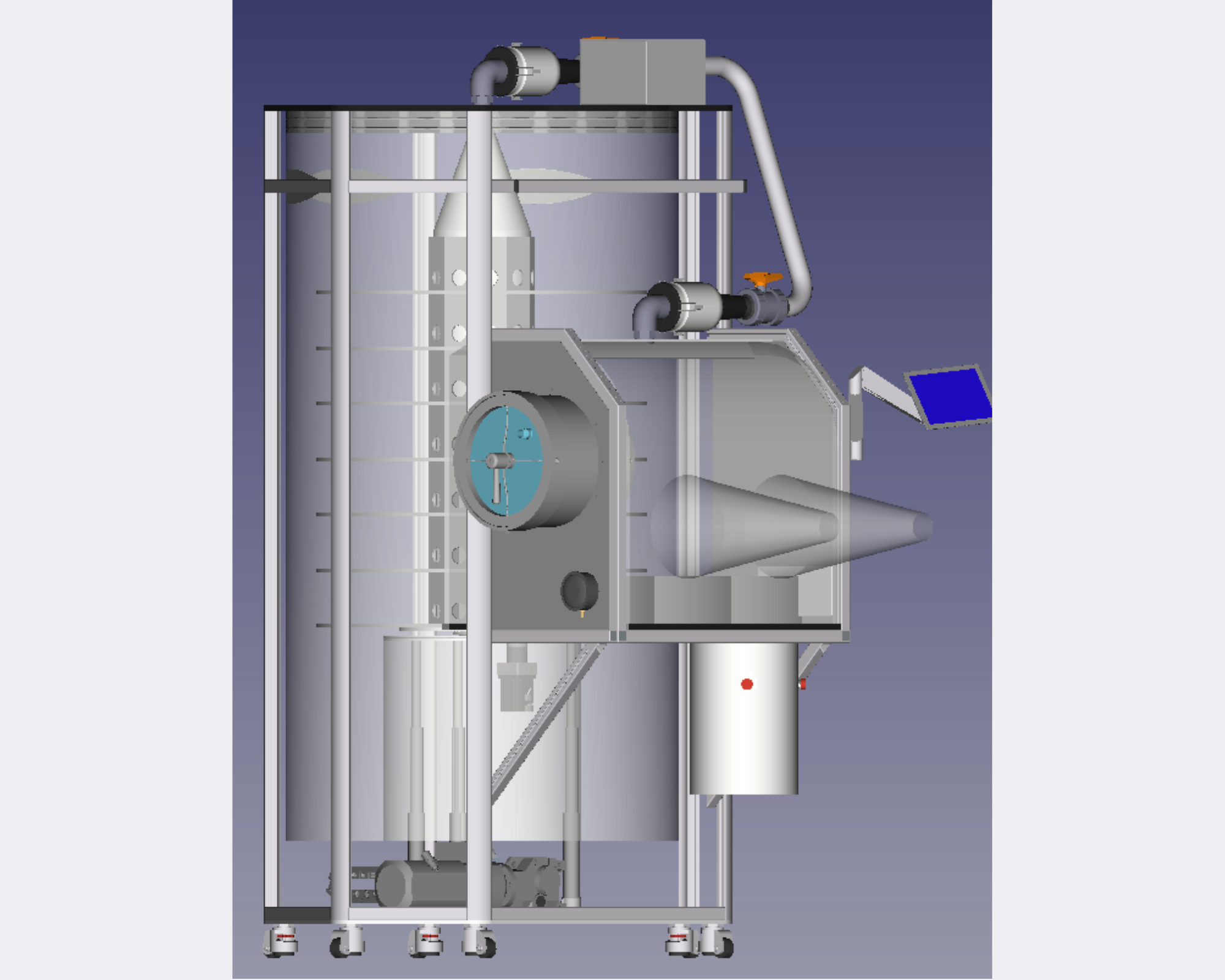
Responding to these converging structural, economic, and scientific drivers, Galilei developed IsoSpin as a mobile clean room platform featuring a hermetically sealed clean room bubble within a modular frame, delivering containment performance comparable to traditional facilities while requiring only a 1.20 × 2.80 m footprint; as a result, institutions gain cleanroom capacity without building expansion, reducing construction costs, approval timelines, and facility downtime.
Operational Efficiency and Workforce Leverage
The cylindrical multi-level rack system with external lifting and rotation drives improves ergonomics and workflow continuity, while integrated software guidance enables animal handling and documentation in a single closed-loop process; this reduces contamination risk, lowers training requirements, shortens process time, and translates directly into labor efficiency gains in an environment characterized by skilled staff shortages.
Process Standardization and Compliance
A novel cage-change mechanism minimizes direct animal handling, supporting welfare while decreasing procedural variability; simultaneously, automated logging and guided dialogs create standardized, traceable workflows, reducing documentation errors and supporting audit readiness with lower administrative overhead.
Digital Integration and Adoption Economics
IsoSpin integrates via the CageTalkers interface into existing animal management systems, preserving prior IT investments and minimizing integration barriers; thus, adoption risk, transition cost, and operational disruption remain low — a decisive factor in institutional procurement.
Investment Thesis
Ultimately, IsoSpin reframes cleanroom infrastructure as a scalable platform asset that improves utilization rates, reduces lifecycle costs, supports workforce productivity, and aligns capital deployment with actual research activity — positioning the system at the intersection of a hardware replacement cycle, digital workflow transformation, and rising performance requirements in preclinical and biotech research.
| Technical data: | |
| Number of cages/containers: | Up to 80 for animals and materials, 10 per level, more depending on room height |
| Frame: | Modular system |
| Space requirement: | 1.20×2.80×2.50m |
| Lift: | 70cm to 500 kg 15 cm/sec |
| Rotation: | 360° in 18 sec. Endless in both directions |
| Cage request: | With arm keypad or integrated keypad and corresponding proprietary software. Automatic shortest route calculation |
| Approach: | Individually adjustable |
| Braking: | Individually adjustable |
| Shelving and cage system variant 1: | Standard carousel rack with cages |
| Shelving system variant 2: | Carousel rack in-house development for cage with non-return flap |
| Cage for automatic change: | Cage with automatic opening of a non-return flap when pushed together |
| Cage recognition: | RFID via reader in the workboard or reader on the belly and corresponding proprietary software. |
| Automatic cage change: | with cobot, problem procedure for sick animals |
| Data entry: | Keypad on the arm or integrated into the workboard and |
| Air exchange: | 2 blowers with HEPA filter plus valve and measuring device |
| Pressure: | 2 blowers with HEPA filter plus valve and measuring device |
| Humidity: | Regulated room or Scanklime. 2-step in-house development |
| Temperature: | Regulated room or Scanklime. 2-step in-house development |
| Light: | Room or outdoor LEDs |
| Cage data: | Initial equipment via CageTalkers interface |
| Management software: | Virtual Changing Station (VCS), proprietary software |
Transferring animals
Mr. Stephan Hammelbacher
Email: sh@galileisoftware.com
Mobile: 0049(0)1717670456
Professor-Max-Lange-Platz No. 6, 83 646 Bad Tölz, Germany